
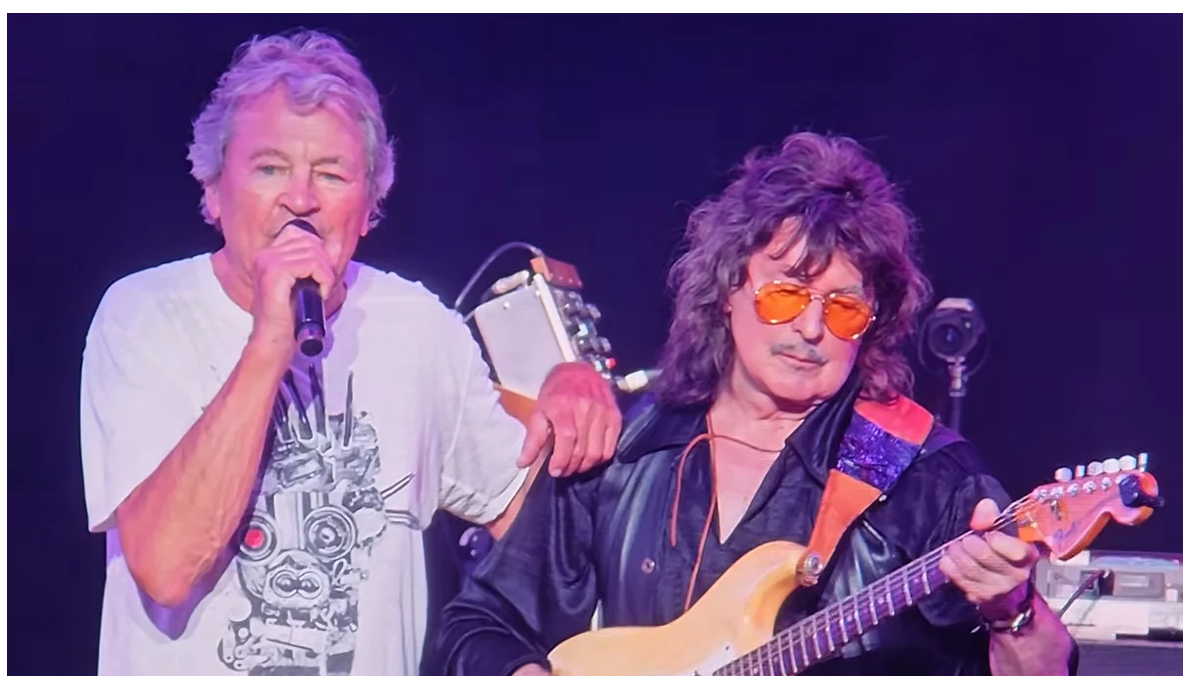
Deep Purple and their ongoing lineup changes have been the soundtrack of my life. At last count, there have been 14 members of the band (15 if you count Joe Satriani, who filled in on tour when Ritchie Blackmore walked out). Various iterations of the band and their family tree (Whitesnake, Rainbow, Gillan, four other direct links and, according to Google, fifty bands with traceable connections) have been producing music consistently since 1968.
The music has been largely good to great and incredibly varied.
That’s half the story.
The other half has been the ongoing, near-soap-operatic drama between Ritchie Blackmore and the members of the Mk 2 lineup (Ian Gillan, Roger Glover, Ian Paice, and the late Jon Lord). The conflict has largely centred around the two Alpha male characters, Blackmore and Gillan. Both men are supremely talented; neither could be described as humble, and while they were briefly on the same page for a glorious three- to four-year period, the simple fact is that the band hasn’t been big enough to accommodate their competing visions and egos.
And that’s OK. Nothing stays the same. Catching lightning in a bottle once is hard enough. The Mk2 lineup did that at least twice with In Rock and Made In Japan, but they were never going to keep doing it, precisely because Blackmore, Gillan (and Lord to a lesser extent) all had competing visions of where they thought the band should go. Unlike some other bands, they were never going to be content regurgitating the equivalent of Machine Head for a couple of decades. There simply had to be progress.
Blackmore won the initial battle, and Gillan, along with Glover, left.
Deep Purple fans have been the beneficiaries ever since
Initially with the Mk 3 albums (featuring David Coverdale on vocals and Glenn Hughes on Bass), Burn and Stormbringer, but then with a rash of quality albums produced by offshoot bands: Ian Gillan Band, Rainbow, Gillan, and, in time, Whitesnake.
They went their separate ways, and they all produced the music they wanted in an environment they could control. Consider these classic tracks from various bands from 1976 to 1984 (with Purple members listed in brackets).
- Stargazer – Rainbow (Blackmore)
- Mr Universe -Gillan (Gillan)
- Gates Of Babylon – Rainbow (Blackmore)
- Scarabus -The Ian Gillan Band (Gillan)
- Fool for Your Lovin – Whitesnake (Coverdale, Paice, Lord)
- Lost in Hollywood -Rainbow (Blackmore, Glover)
- Here I Go Again – Whitesnake (Coverdale, Lord, Paice)
- On the Rocks – Gillan (Gillan)
- Kill the King – Rainbow (Blackmore)
- Bluesy Blue Sea- Gillan (Gillan)
- Street of Dreams – Rainbow (Blackmore, Glover)
- Ain’t Gonna Cry No More -Whitesnake (Coverdale, Paice, Lord)
Those tracks cover a vast range of styles, genres and attitudes from the experimental jazz rock of the Ian Gillan Band, the sophisticated Blues rock of Whitesnake, the neo-classical proto-metal style of the early Rainbow years, the new wave hard rock of Gillan, to the AOR-friendly (some would say sell-out) later Rainbow tracks. There is no way that one band could produce all of those styles, and perhaps none of those tracks would have been brought to fruition if the various band members had chosen to remain within the confines of Deep Purple.
But that Mk 2 lineup was special. There was a magic there that they had to try and recapture. They got together and made a pretty good fist of it with Perfect Strangers, but those competing visions (and egos) soon got in the way. By the time they got around to the follow-up album House of Blue Light, the cracks weren’t just showing; they were developing into major fault lines.
Gillan left again, but was soon brought back after Slaves and Masters, perhaps revealing that Purple needed someone to push back against all of Blackmore’s controlling nature. The subsequent aptly titled The Battle Rages On album and tour reached its climax when Blackmore spat the proverbial dummy and resigned.
It was an acrimonious, bitter, and tumultuous time for all involved. Perhaps things were said that were better left unsaid. It was what it was. The band played on. Blackmore reimagined Rainbow, and they went their separate ways.
With Blackmore gone, Deep Purple embraced a more eclectic and diverse style, drawing heavily on the input of replacement guitarist Steve Morse. The album Purpendicular is arguably one of the band’s finest, but it is a far different beast to Machine Head or even Perfect Strangers. More than any other album since, the album explores the diverse influences and motivations of all band members and perhaps hints at the central clash of vision between Blackmore and everyone else.
That clash of professional vision and ego got petty and personal. It reached its nadir in 2016 when Deep Purple were inducted into the Rock and Roll Hall of Fame. It’s hard to understand what happened exactly, but watching from afar, I think it’s fair to say that Gillan in particular got his nose out of joint because not all Deep Purple members were inducted. (Original bassist Nick Simper, guitarists, Steve Morse and Tommy Bolin, vocalist Joe Lynn Turner, and keyboardist Don Airey were arbitrarily left off the list.) From there, it became something of a shit show, with Gillan insistent that the 2016 lineup and nobody else perform on the night. Blackmore said he wasn’t coming, leaving Coverdale and Hughes hanging.
While the induction was something of a triumph for fans, it seemed to reopen old wounds and underscore the deep division among musicians who had once been united.
Deep Purple are still writing and performing music. Blackmore has recently communicated that due to various health issues, his live performances with his band Blackmore’s Night will be limited to local appearances. Both Gillan and Blackmore are in their eighties. Neither of them would claim to be the performers that they once were. They’re both battling health conditions. They still both love music, and they’re incredibly proud of their legacy.
That legacy is a shared one.
Both men have made some conciliatory noises over the past couple of years. They have seemed genuine enough, but they were not necessarily earth-shaking. There was no indication that there would be any type of reunion until, in typically unpredictable fashion, this happened.
It took a while to sink in, and given all the bad blood over the years, I sort of expected either Ritchie to pull out or Gillan to say no.
But it happened, and I was surprised by the wave of emotion that swept over me, as the man in black, complete with obligatory white Strat, pilgrim’s hat and rock and roll wig, strode out to join the band on stage for a rendition of Smoke on the Water.
Let’s be honest. He looked like an 80-plus-year-old man who hadn’t been practising for a very long time. That didn’t matter. He was there. He wanted to be there, and he was welcome.
All those years of conflict and aggression seemed to melt away. Gillan and Blackmore embraced. Gillan paid tribute to the “immortal genius, Ritchie Blackmore,” and that part of the internet that still cares about such things went absolutely nuts.
Despite their musical genius and obvious musical and personal differences, these two men stood united once again. The circle seemed complete.