
So, let’s get one thing straight. I like Led Zeppelin. I like them a lot. If push came to shove, I might list them in my top ten favourite bands – they would certainly make my top twenty. But…..I’ve never really understood what all the fuss was or is about.
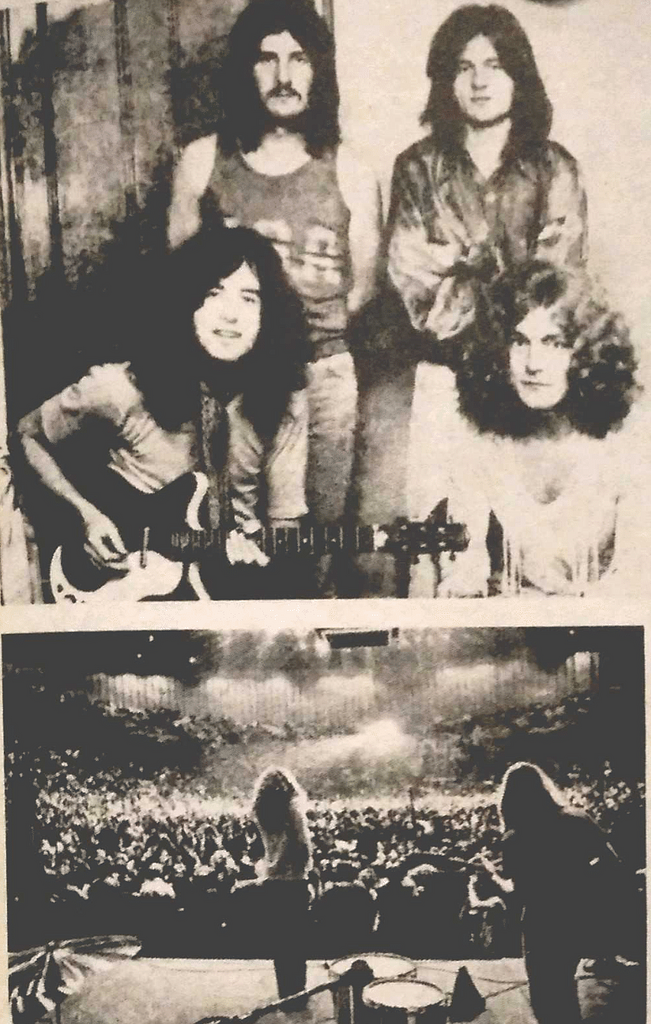
Mostly, they are a four-piece blues-rock band who were louder than their predecessors. Their first two albums, in particular, are very good heavy blues-rock albums, with the occasional dead-set banger (Whole Lotta Love, Communication Breakdown, Heartbreaker, and maybe Bring It On Home). Individually, they were four very good rock musicians, who were recognised around the London circuit as being in the upper echelon. Jimmy Page was an excellent blues/rock guitarist, John Bonham was the quintessential heavy rock-and-roll drummer, Robert Plant had the looks and lungs that set the template for generations of male rock vocalists, and John Paul Jones was the rock on which everything else was built.
I started listening to them in 1976 when the album Presence was released. I bought the album blind, having heard staples from earlier albums on the radio; I thought it was a punt worth taking. For the most part, it was. Two tracks really made the purchase worthwhile – Achilles Last Stand and Nobody’s Fault But Mine– but the rest of the album sounded a little bit ordinary. In time, I grew to love Tea For One, but the rest of the album seemed, well, uninspired. Maybe overproduced. I don’t know. The rest of the songs didn’t grab me. But the good stuff was so good that I had to buy more. I bought the entire back catalogue and found that each album (except the fourth) told a similar story. Moments of greatness intertwined with uninspired mediocrity. That will upset a lot of Zeppelin fans, but that’s how I’ve always felt about them. At their best, they’re God-tier, but their best seemed to be out to lunch a lot of the time. That’s just the way I feel about them.
What were Zeppelin Trying to Achieve?
Zeppelin emerged from the ruins of the legendary blues-rock outfit the Yardbirds. Guitarist Jimmy Page envisioned a heavier blues-rock band that would plough similar ground to what the Yardbirds had done. So much so that he originally named the new project the New Yardbirds. That says something about Page the man, as much as the professional musician. Page obviously saw commercial value in the Yardbirds’ brand name, and he was prepared to leverage it for profit.
There’s nothing wrong with that. Life as a professional musician is not easy. Page and the other members of Zeppelin were all professional session musicians, living hand to mouth. Bands like the Yardbirds gave them steady income via live performances and record deals. I imagine Page and the others were doing anything they could to make their chosen profession viable. They did what they had to.
Fortune seems to have favoured them somewhat: they were in the right place at the right time and signed to a record deal, unseen and unheard by Atlantic Records. But the first two albums, especially, followed Page’s original vision of building on the Yardbirds’ heavy blues legacy. It wasn’t really until the third album that Zeppelin began to explore other musical directions. They weren’t the first band to do so, and the path they chose was not exactly new ground, but they went there with Led Zeppelin III, which, with the possible exception of In Through the Out Door, I find to be the least enjoyable of all their albums. But it signalled a willingness to experiment and to push boundaries. Without it, we wouldn’t have the fourth album, and we probably wouldn’t get the classics like Kashmir scattered amongst standard rock fare like Custard Pie.
I don’t think Zeppelin were trying to set a direction or even seek critical acclaim. I think they were willing to explore their creativity, and they were successful enough to take it as far as they wanted. But here’s the thing.
They never went that far.
They were experimental enough to be considered trailblazers, but grounded enough to keep most of their audience on their side. I’m not sure where the line between art and money was, but they (Or was it their manager?) kept well on the money side.
The Myth and the Reality (The Peter Grant Factor)
There is no doubt that Zeppelin were a great band, one of the best of their time. But were they the best, and who decided that?
Zeppelin were fortunate to have Peter Grant as their manager, who marketed them from day one as “the best band in the world.”
It was an incredible time for music, and all sorts of experimental bands were doing the rounds. A handful became legendary. Zeppelin is widely seen as the best of the era today, but most people have no idea who Zeppelin’s contemporaries were. Grant marketed them to be the best. He built a mystique around them, and he sold it well. Zeppelin’s strength was that they were great musicians who didn’t let themselves go too far down the navel-gazing rabbit holes some of their contemporaries got lost in. However, when I look at Zeppelin’s entire discography, I’m not blown away any more than I am by a band like Free.
They were never as heavy as Black Sabbath. Their musicians weren’t on the same virtuoso level as Deep Purple’s members. The music was not as elaborate as Yes. The lyrical content was generic. Pink Floyd was more experimental, and Jethro Tull composed better (more progressive) compositions. But, somehow, Peter Grant managed to convince a large part of the music press, and an even larger part of the musical audience, that Led Zeppelin were the best band in the world.
That’s some achievement.
Plagiarism Allegations
Zeppelin’s willingness to appropriate other musicians’ material and claim it as their own has never sat well with me. Court cases have been won and lost over their use of blues musicians’ material. It’s a fine line. When are you paying homage to what has been before, and when are you just stealing?
I’m too old to get on my high horse over it, and to be fair to Led Zep, they arose in a time when bands like the Rolling Stones were “borrowing” heavily from blues musicians. They weren’t the first band to do it, and they certainly haven’t been the last. I do know that teh ongoing allegations, and Zeppelin’s willingness to fight them in court, have left me uncomfortable about songs like Dazed and Confused, Whole Lotta Love, Nobody’s Fault But Mine, and even Stairway to Heaven.
I’m not sure how that colours my overall view of the band and its legacy.
The Song Remains the Same Album/Movie
Live band performances, for me, are the best measuring stick of a band. Around 1976/77, Zeppelin released a movie that contained a live performance at Madison Square Garden. They also released an album of the live performance. It was hardly earth-shattering. The band performed well, but compared to some other live albums I own and treasure, it simply doesn’t stack up. It seemed contrived and just a little self-conscious. I have heard the setlist was changed specifically for the movie. If so, that validates my feelings about the album. It’s almost as if they were trying too hard.
I am aware of How the West Was Won, which is said to be a better album and more representative of the band’s better live performances. I haven’t listened to the whole performance. What I’ve heard is better than the Song Remains the Same, but it doesn’t reach teh heights of Made in Japan, for example. Maybe that’s because a four-piece is limited musically compared to a five-piece.
Final Verdict
Music moves people differently, and I make no apology for having an opinion that sits outside the accepted mainstream truth when it comes to Led Zeppelin. I think they were a great band who were better in the studio than live. All four musicians were great, and some of their songs are absolutely legendary. But I rarely feel the need to listen to them, and I never sit down and listen to an entire album all at once. I have go-to songs I really enjoy, but there is also a lot of material I have no desire to listen to ever again.
Essential Led Zeppelin Listening
This is my list, and it doesn’t include some “standards.” I think Stairway is overrated and Rock and Roll is near filler. That said, here’s my list in something like chronological order.
- Communication Breakdown (from the 1st album)
- Whole Lotta Love (Led Zeppelin II)
- Heartbreaker (Led Zeppelin II)
- Bring It On Home (Led Zeppelin 11)
- Immigrant Song (Led Zeppelin III)
- Black Dog (Led Zeppelin IV)
- Going to California (Led Zeppelin IV)
- When the Levee Breaks (Led Zeppelin IV)
- Over the Hills and Far Away (Houses of the Holy)
- The Ocean (Houses of the Holy)
- Trampled Underfoot (Physical Graffiti)
- Kashmir (Physical Graffiti)
- The Wanton Song (Physical Graffiti)
- Achilles Last Stand (Presence)
- Nobody’s Fault But Mine (Presence)
- In the Evening (In Through the Outdoor)