
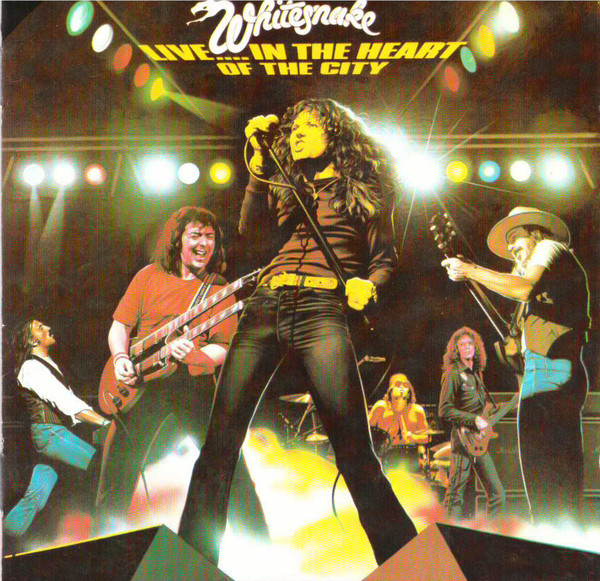
In the early eighties, I considered Whitesnake the heavyweight champion of polished, sophisticated hard rock. They had a great lineup of talented musicians, a superb frontman (David Coverdale), and a growing catalogue of heavy music intelligently rooted in the blues without sounding derivative. With Zeppelin having called it a day, Deep Purple in seeming permanent recession, and Rainbow straying into radio-friendly AOR, Whitesnake seemed positioned to claim the number one spot in that subgenre of bands too heavy to be radio-friendly, but too diverse to be simply characterised as “heavy metal.”
The album Live in the Heart of the City came out in 1980, when the band was at the top of its game, having released the superb Ready and Willing that same year. While released as a double album that showcased two shows from 1978 and 1980, in the UK (and presumably Europe), Australian fans (me and a couple of others) only got the 1980 tracks on a single disc.
It was well worth the price, featuring tracks Come On, Sweet Talker, Walking in the Shadow of the Blues, Love Hunter, Ain’t No Love in the Heart of the City, Fool for Your Lovin and Take Me With You; the album reinforced my faith in that lineup and encouraged me to buy the back catalogue as well as continue to shell out money for the ensuing albums that largely featured the core elements of this blues/rock focussed band.
Whitesnake’s Best Lineup.
This album featured what many fans consider its best, and perhaps most harmonious, lineup. David Coverdale (vocals) had convinced his former Deep Purple colleagues Jon Lord (keyboards) and Ian Paice (drums) to join his twin lead guitarists Bernie Marsden and Micky Noody and bassist Neil Murray in what was, for a period of three years or so, a united enterprise focussed on producing quality music. While the band was determined, and perhaps even obsessed, with downplaying its links to Deep Purple, its sound was not that far removed from Deep Purple Mk IV. Different, more restrained perhaps, but certainly related.
Perhaps the key dynamic was the twin-guitar sound Moody and Marsden could produce. Both players complemented each other, giving the band more nuance and colour than many of its contemporaries. Neither player was weighed down with a guitar hero’s ego. This seemed to allow the band to breathe and stretch out without becoming self-indulgent. Lord seemed content to take a backward step and play a supportive role with the occasional blistering solo, while Paice’s musicianship and jazz roots gave the band an extra sense of swing.
The Coverdale Moody Marsden Triumvirate
Make no mistake. This was always David Coverdale’s band, and in the early days he had a clear sense of direction. His recruitment of guitarists Micky Moody and Bernie Marsden reflected that vision. The trio collectively wrote the band’s material with occasional contributions from other members. This united front allowed the band to explore and mine a rich vein of blues-centred music. The guitar players’ impact on the band’s overall success stretched well beyond their time in the band, with some of their songs “tarted up” for the smash self-titled album in 1987.
While other members had bigger names, they were essentially a supporting cast to this inner songwriting unit. The connection was so close that I could never think of one guitarist without ever thinking of the other. Moosy/Marsden was every bit as dynamic and important as the guitar heroes of the early eighties, with flashier chops, bigger hair, and cultivated bad-boy images. The duo had no time for musical gymnastics, swagger or posing. They just played the right notes at the right time, and both looked like they would be right at home wandering into the local pub one evening. Coverdale, on the other hand, was the consummate frontman, with the swagger of a Jagger or a David Lee Roth, and better vocal ability than either of them. In this sense, Moody and Marsden provided the perfect foils to his performances.
While these three remained together, quality music and performances seemed assured.
The Tracks
Since I only have the single album released in Australia, I will keep my comments limited to those tracks. I am aware of the other album, but I’ve never heard it. It contains some Purple numbers (Mistreated and Might Just Take Your Life), and having heard Coverdale sing these live, I’m sure that they are excellent.
The track listing I am familiar with is related to a show performed in 1980
Come On is an excellent show opener. This riff-based rocker was one of Whitesnake’s earliest, appearing on their debut EP Snakebite. The fact that it remained the set opener years later speaks volumes.
Sweet Talker is another great rocker with some lovely guitar harmonies, a driving underlying riff and s ublime hammond solo from Jon Lord
Walking In the Shadow of the Blues is pure 1980 Whitesnake. A heavy almost menacing riff with some beautiful tasteful lead guitar over the top, gives way to some great vocal delivery from Coverdale.. This near-anthemic statement-of-purpose tune is, to my mind, the album highlight.
LoveHunter is another great song that explores the blues and ventures into less-charted waters. This live version features an extended solo from Micky Moody; it is typical Moody: understated, clever, and enjoyable. If you’re expecting a showcase of virtuoso skills, you’ll be disappointed. Enjoy it for what it is.
Ain’t No Love In the Heart of the City is often cited by fans as the highlight, and is universally considered a Whitesnake classic. It is the only track on the album not written by the band; it’s a reworking of a Bobby Bland blues song. The song is slowed down, giving Coverdale the room to deliver a masterful, soulful rendition of an emotive love song. On the live version, Coverdale conducts crowd participation brilliantly.
Fool for Your Lovin’ is another great riff-based rocker that gave the band its first UK top-20 hit. I personally think the recorded version on Ready and Willing is as good as Whitesnake ever got, with a remarkable balance of hard rock, dynamics, and soulful blues-based vocals. Live, it’s pretty damn good, but it becomes more of a foot stomper and loses some of the recorded version’s subtlety.
Take Me With You is an energetic set closer that probably doesn’t quite match the impact of the other tracks. It is good, but it just doesn’t quite match some of the other material.
Overall Impact
This album catches early Whitesnake at its absolute peak in performance, songwriting, and vision. That peak extends into the next studio album (Come and Get It), then slowly wanes as band members disappear voluntarily or otherwise. Most long-term Whitesnake fans list Come and Get It and Ready and Willing as Whitesnake’s two best albums, and this live album captures their live performance between them.
The album charted in the UK, peaking at #5, while its impact in the US was minimal (146), and it went completely unnoticed in Australia, with minor success in Germany and Japan. That’s a pity.
Today teh album is widely regarded in classic rock circles as one of the best live albums of the classic rock period. It isn’t Made in Japan or even Live and Dangerous (Thin Lizzy), but it is a very good representation of a classic band doing classic things. I rate it highly and, if push came to shove, would rate it 4,5 stars out of 5
Final Thoughts
This is the Whitesnake that I loved. Tasteful, professional, heavy but restrained at the same time. This lineup had a chemistry that future incarnations would fail to emulate. I treasure this album and have often lamented that the powerful triumvirate of Coverdale, Moody, and Marsden could not remain united, and that future incarnations of the band became increasingly compromised by the pursuit of the American market and the almighty dollar.